Introducing Concurrency Ramp-Up
GoStress now supports ramping from 1 to N workers over a configurable duration. Learn why gradual concurrency matters and how to use the new --ramp flag to uncover saturation points without overwhelming your target.
One CLI command. Beautiful HTML reports with charts. No complex YAML. No configuration headaches.
Dark-themed reports with interactive charts, latency percentiles, and diagnostic insights — generated from a single CLI command.
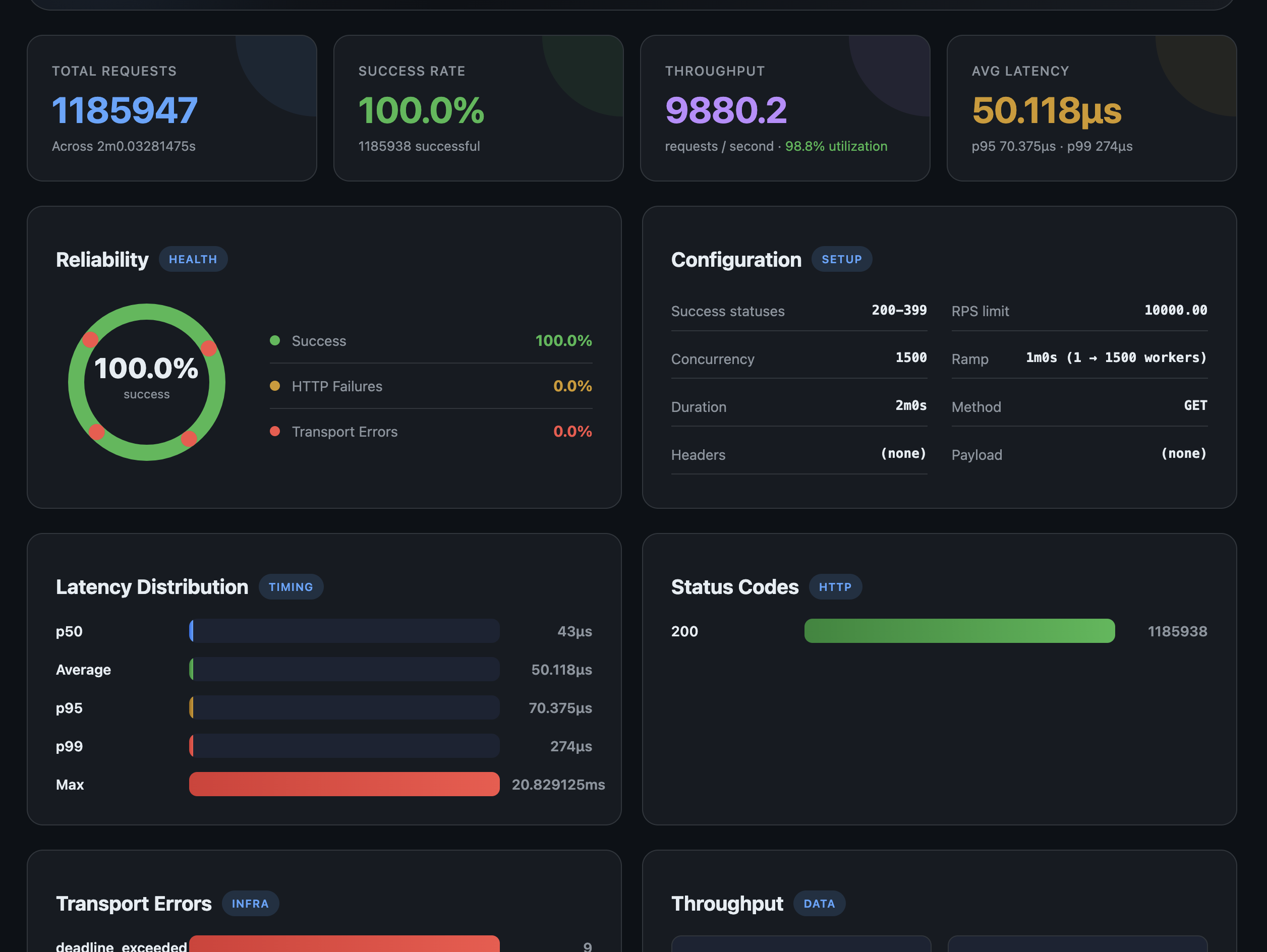
Everything you need for stress testing, nothing you don't.
Interactive charts for latency, reliability, status codes, and transport errors. Visual insights, not just numbers.
No complex YAML. No configuration files. Just intuitive flags that make sense from the first run.
Launch a protected web UI to view and share reports. Perfect for teams and CI/CD pipelines.
Cap your request rate across all workers. Control your load with precision and safety.
Define exactly which HTTP status codes count as success. Perfect for APIs with custom error codes.
Completely free to use, modify, and distribute. Built with Go, open for contributions.
Run your first stress test in under 30 seconds
Join a growing community of developers using GoStress
Updates, guides, and deep dives from the GoStress team.
GoStress now supports ramping from 1 to N workers over a configurable duration. Learn why gradual concurrency matters and how to use the new --ramp flag to uncover saturation points without overwhelming your target.
A walkthrough of every section in the GoStress HTML report — from KPI cards and donut charts to latency percentiles and transport error diagnostics.
PerformanceWhat the new utilization percentage means, when to worry about it, and how to tune your concurrency and RPS limits to hit target throughput.
Deep Divedeadline_exceeded, connection refused, EOF — what each transport error actually means at the TCP level and how to interpret them in a load test.
GuideHow GoStress gives you production-grade load testing with no external dependencies — no JVM, no Node, no Python. Just a single binary and a terminal.
Get started in 2 minutes. It's free, open source, and built for developers.